One to One Documentary Photography Workshops in Porto
Private sessions with photojournalist Daniel Rodrigues. One participant, one city, and as many days as the work needs

There is one participant. That changes everything about how the days run.
We start at center of Porto at ten in the morning, with theory: exposure, light, composition, how a photo story holds together. Then we go out. Bolhão market, São Bento, the Sé, Miragaia, the stairs down to Fontainhas. Where we go depends on the light and on what you want to work on, and it changes during the day if something better is happening two streets away.
I have photographed in more than thirty countries and I have been shooting for The New York Times since 2015. The method I use on assignment is the method I teach here. It is not complicated. Most of it is about slowing down.
Between shooting we sit down, look at the files, and talk about what worked. By six in the evening you have photographed for six hours and edited twice. That is a real day.
Who this workshop is for
Who this workshop is for
Photographers who already shoot regularly and cannot work out why the pictures do not add up to anything. That is the most common case.
It also works for people starting from zero. With one participant, there is no group to hold back, so if you have never used manual exposure, we start there, and if you have been shooting for fifteen years, we skip straight to editing and sequencing.
The one thing that does not work is wanting a photo tour. If you want someone to walk you to the good viewpoints, this is the wrong booking.

What you will truly gain
What you will truly gain
The focus is not on tricks or formulas, but on decision-making. This is about learning how to read situations, make choices in the field, and work with intention.
The skills developed during the workshop remain useful long after it ends, whether you are working on personal projects or professional assignments.
In practice, you will learn to:
- Exposure. What a stop is, and why the aperture ring, the shutter dial and the ISO dial all move in the same currency. Full tables for f/1.4 to f/16 so you can see the trade.
- Depth of field. Focus is a band, not a point. At three metres, f/1.4 gives you 47 centimetres of sharpness. At f/16 you get 23.7 metres. We work with both.
- Highlights and shadows. A RAW file keeps whispering in the dark. A blown sky has nothing inside it. House rule: shoot one to two stops under and live there.
- Composition. Six exercises with names: rule of thirds, line hunting, light and shadow, the minimalist moment, the decisive moment, urban symmetry. Ten frames each.
- Approaching people. The part everyone is afraid of. Be genuine, say what caught your attention, talk before you lift the camera, ask to make the portrait rather than take it, offer to send the file.
- Seeing before shooting. Six steps: stop, analyse, move, build the frame, wait, press. The button is the easy part. Eighty per cent of the work happens before your finger moves.
- Building a story. The five shots a sequence needs: establishing, portrait, detail, action, closing. Ten portraits in a row is boring. Ten landscapes has no people in it.
- Editing. The photographs you leave out are what make the story. Ten frames with rhythm beat fifty good ones in random order.
- Tonal consistency and flow. Squint at your sequence. If one frame jumps out, it does not belong. If someone in frame A looks right, the subject in frame B enters from the left.

Available formats
Available formats
One Day One-to-One Photography Experience | Documentary walk through Porto or Lisbon | Workshop | Photo walk
One Day One-to-One Photography Experience | Documentary walk through Porto or Lisbon | Workshop | Photo walk
One day, one participant, no group. Ten in the morning to six in the evening, on foot, in the city.
We meet in Batalha, right in the city centre. We spend the first hour going through the fundamentals: exposure, understanding light and how to build a strong photograph. After that, we head out into the streets.
We usually start around Bolhão Market, then make our way through São Bento, and down to the riverside. If the light is better elsewhere, we change direction. There is never a fixed route. We follow the city, the light and whatever is happening around us.
We stop three or four times to look at the files together. Not at the end, during. That is when you learn something, while you can still go back and shoot it properly.
This is not a photo tour. Nobody walks you to the viewpoints. What you leave with is a way of deciding what to photograph and what to ignore, which is the part that keeps working after you go home.
Duration
6 to 8 hours (usually 10:00 to 18:00)
Location
Porto, Portugal.
Also available in Lisbon or another city by prior arrangement
Price
600 € | 700 USD
Who this experience is for
People passing through Porto for a few days who want one of them to be different. People who photograph regularly and want an honest opinion from someone who does this for a living. People who have never used manual mode and want to stop being afraid of it.
You do not need a professional camera.
If you are travelling light I can arrange a Fujifilm rental kit for the day.
What we cover in one day
Exposure and what a stop actually is. Reading light in the street. Framing with intention rather than reflex. Approaching people and asking for a portrait without it being awkward. A first edit, together, at the end. Not everything above fits into one day. What fits depends on where you are starting from, which is the advantage of there being only one of you.
After
Your photographs go onto your page in my workshops platform. I rate them and write notes. The page stays open, so if you shoot something in six months and want a second opinion, you upload it and I answer.
Available formats


Multi-Day Intensive Workshop
Multi-Day Intensive Workshop
The difference between one day and several is not more hours. It is that you get to be wrong on Tuesday and fix it on Wednesday.
On a single day I can tell you what is not working. Over several days you go back into the same streets with that knowledge, shoot again, and see whether it held. That is how photographers actually improve. It does not happen in an afternoon.
We build one story across the days. A theme, defined early and narrowed as we go, shot properly, then edited and sequenced into something that holds together from first frame to last. Not a collection of good pictures. A series.
Format
Modular by days. Sessions do not need to be consecutive. Some people spread five days across two visits to Porto, which works well because the gap gives you time to shoot alone and come back with questions.
Location
Porto, Portugal
Also available in Lisbon or elsewhere by prior arrangement.
Price
2 to 4 days: 550 € | 650$ per day
5 days: 500 € | 590$ per day
How the days build
Days 1 and 2, foundations in the street
Exposure applied to narrative rather than as an exercise. Advanced composition. Reading urban light, which in Porto changes character between the granite of Baixa and the water reflection down at the river. Approaching people, and doing it enough times that it stops being difficult. By the end of day two, you should have a theme.
Days 3 and 4, building the story
The theme gets narrowed. Visual continuity, rhythm and variety across frames, and the discipline of shooting what the story needs rather than what is in front of you. First editing decisions happen here, not at the end, because knowing what you are missing changes what you shoot the next morning.
Day 5, edit and sequence: The final edit.
Building a narrative from opening frame to closing one. An editorial conversation about the work: what it is, who it is for, and what to do with it. Preparation for a portfolio or a pitch, if that is where you want it to go.
Working on a real subject
The point of these days is to pick a theme and stay with it. Some themes you can find on your own in the street. Others need arranging beforehand, and that is where we can go further than a walk through the city.
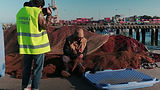
Depending on what interests you and what the calendar allows, we can organise a shoot around a live event, theatre or a concert, where you work with stage light, no second takes and no control over anything. We can rent a studio and hire a model, so you spend a day on controlled light instead of found light. We can go out to the coast and photograph the fishing: the boats coming in at dawn, the auction, arte xávega hauled up onto the sand by tractor, or a full day in a fishing village following one family through their working day.
These are not add-ons for the sake of it. Each one gives you a different problem to solve, and a body of work with a beginning and an end rather than a set of frames from a city.
Some of these involve costs beyond the workshop fee, studio rental, a model, and transport. We agree on it in advance, before anything is booked.
What you leave with
A finished series, edited and sequenced, and a working method for the next one. The images matter less than knowing how you got to them.
Most photographers do not have a problem taking good frames. They have a problem turning twenty good frames into one thing that means something. That is what these days are for.
Workshop platform
Everything goes onto your own page on my workshop platform: uploads sorted by day, ratings frame by frame, written notes, and a panel tracking five things across the workshop: reading light, composition, approaching people, narrative, and editing.
The page does not close when the days end. You upload new work whenever you have it and I answer. No time limit, no extra charge.
Workshop's Platform
Workshop's Platform
Before you arrive, I set up a page for you, in English, Portuguese, or French. It has the day-by-day programme, the meeting point, and a Porto guide I keep updated: hotels filtered by price and neighbourhood, restaurants I actually eat at, thirteen walking routes with every waypoint already loaded into Google Maps, and whatever photography exhibitions are open that week.
During the workshop you upload your photographs there, sorted by day. I go through them, rate them one by one, and write notes. There is a panel that tracks five things across the days: reading light, composition, approaching people, narrative, and editing.
Your page doesn't close when the workshop does. Six months later, if you shoot a series and want a second opinion, you upload it and I answer. There is no time limit and no extra charge. Most of what I learned about photography I learned from someone looking at my work and telling me the truth about it, and that does not happen in three days.
Only you can see your page. I have access for teaching.
Testimonials from workshop participants
Testimonials from workshop participants
Sophie
Brest, France
"A workshop with Daniel is a total immersion in photography, intense work and a real enrichment on the technical, creative and human level alike. His refusal to settle makes you move forward at a wild pace, and a few days are enough to take great steps.
Daniel pushes us, with kindness and method, to get past our fears, correct our mistakes and become better photographers."
Anna
Italy
"There is one thing Daniel does better than anyone else: he leads by example. He shoots alongside the group, and you won't be surprised to find him having a coffee with you and then suddenly sprinting off to capture a shot.
He makes photography a mindful experience and a shared joy rather than an exercise in aimless perfection."
Location
Location
These one-to-one workshops are based in Porto, a city with a strong documentary rhythm, layered urban life, and constantly changing light.
With prior planning, the workshop can also take place in Lisbon or other locations, in Portugal or abroad.

How much does it cost?
One day is 450 €. Two days are 400 € per day. Five days are 350 € per day. Sessions run 10:00 to 18:00.
Do I need a good camera?
Any camera works, including a phone. If you are travelling without one, I can arrange a Fujifilm rental kit for the duration of the workshop, which is what I did in July for a participant who came from Taiwan with hand luggage only.
I have never used manual mode. Is that a problem?
No. With one participant, we start where you are. Exposure takes about two hours to understand and the rest of the day to get comfortable with.
What is the difference between this and a photo tour?
A photo tour takes you to viewpoints. This does not. We work in Bolhão, Miragaia, Fontainhas and Bonfim, where people live, and the point is what you learn rather than the pictures you leave with.
What if it rains?
Porto rains. Wet cobblestones reflect, umbrellas make shapes, people move differently. The plan changes, the day does not stop.
Where should I stay?
Ribeira, Cedofeita or Clérigos put you within walking distance of everywhere we work. The platform has a filtered list with prices and neighbourhoods.
Can we do this outside Porto?
Yes, with notice. Elsewhere in Portugal or abroad is possible if the dates work.
What do I bring?
Camera, two batteries, spare cards, and a laptop with Lightroom or Capture One for the editing sessions. Shoes that handle cobblestones and hills. Porto is steep.
Will I have publishable work at the end?
Some people do. It depends on the days, the light and what we find. What you will definitely have is a method for building a series, which is the part that keeps working after you go home.
Can I keep working with you afterwards?
Yes. Your page stays open and you can upload new work whenever you have it.
About Daniel Rodrigues
About Daniel Rodrigues
Daniel Rodrigues is a photojournalist and documentary photographer. He won the World Press Photo in 2013, has been a regular contributor to The New York Times for over a decade and has worked in more than thirty countries, from conflict zones to isolated communities, major cities and everyday stories.
In these workshops, Daniel shares not only technical knowledge but also the way he thinks, observes, prepares and engages with people, constructing narratives that make sense to him and to the editors he works with.

FAQ - Frequently Asked Questions
FAQ - Frequently Asked Questions
A one to one documentary photography workshop is an intensive learning format designed around the individual photographer. Unlike group workshops, it allows the pace, structure and focus of the sessions to be adapted entirely to the participant’s experience, interests and objectives. This format is particularly suited to photographers who want to deepen their documentary approach rather than follow a predefined programme.
One to one workshops prioritise direct interaction between photographer and mentor. This allows for detailed discussion of shooting decisions, visual language and narrative intent. Feedback is continuous and specific, addressing strengths, limitations and areas for development in a precise and practical way. The learning process becomes more reflective and tailored, supporting long-term growth rather than short-term results.
Porto provides a strong context for documentary photography, with layered urban life, varied light and constant human presence. One to one workshops take place in real environments, encouraging participants to observe carefully, respond to unfolding situations and work with available light. The city becomes an active learning space rather than a controlled setting.
A key component of one to one documentary workshops is the analysis of images produced during the sessions. Editing and sequencing are approached as essential parts of the storytelling process. Discussing image selection, rhythm and narrative coherence helps photographers understand how individual photographs function within a broader visual story.
This format is suited to photographers seeking focused development, whether refining an existing documentary project or clarifying their visual direction. The individual structure allows space for critical discussion, experimentation and consolidation of a personal approach. One to one documentary photography workshops emphasise observation, context and intentional decision making as the foundation of meaningful visual work.
One day is 600 €. Two days are 550 € per day. Five days are 500 € per day. Sessions run 10:00 to 18:00.
Any camera works, including a phone. If you are travelling without one, I can arrange a Fujifilm rental kit for the duration of the workshop, which is what I did in June for a participant who came from US with hand luggage only.
No. With one participant we start where you are. Exposure takes about two hours to understand and the rest of the day to get comfortable with.
A photo tour takes you to viewpoints. This does not. We work in Bolhão, Miragaia, Fontainhas and Bonfim, where people live, and the point is what you learn rather than the pictures you leave with.
Porto rains. Wet cobblestones reflect, umbrellas make shapes, people move differently. The plan changes, the day does not stop.
Ribeira, Cedofeita or Clérigos put you within walking distance of everywhere we work. The platform has a filtered list with prices and neighbourhoods.
Yes, with notice. Elsewhere in Portugal or abroad is possible if the dates work.
Camera, two batteries, spare cards, and a laptop with Lightroom or Capture One for the editing sessions. Shoes that handle cobblestones and hills. Porto is steep.
Some people do. It depends on the days, the light and what we find. What you will definitely have is a method for building a series, which is the part that keeps working after you go home.
Yes. Your page stays open and you can upload new work whenever you have it.